
The Dark Side of Greek Mythology
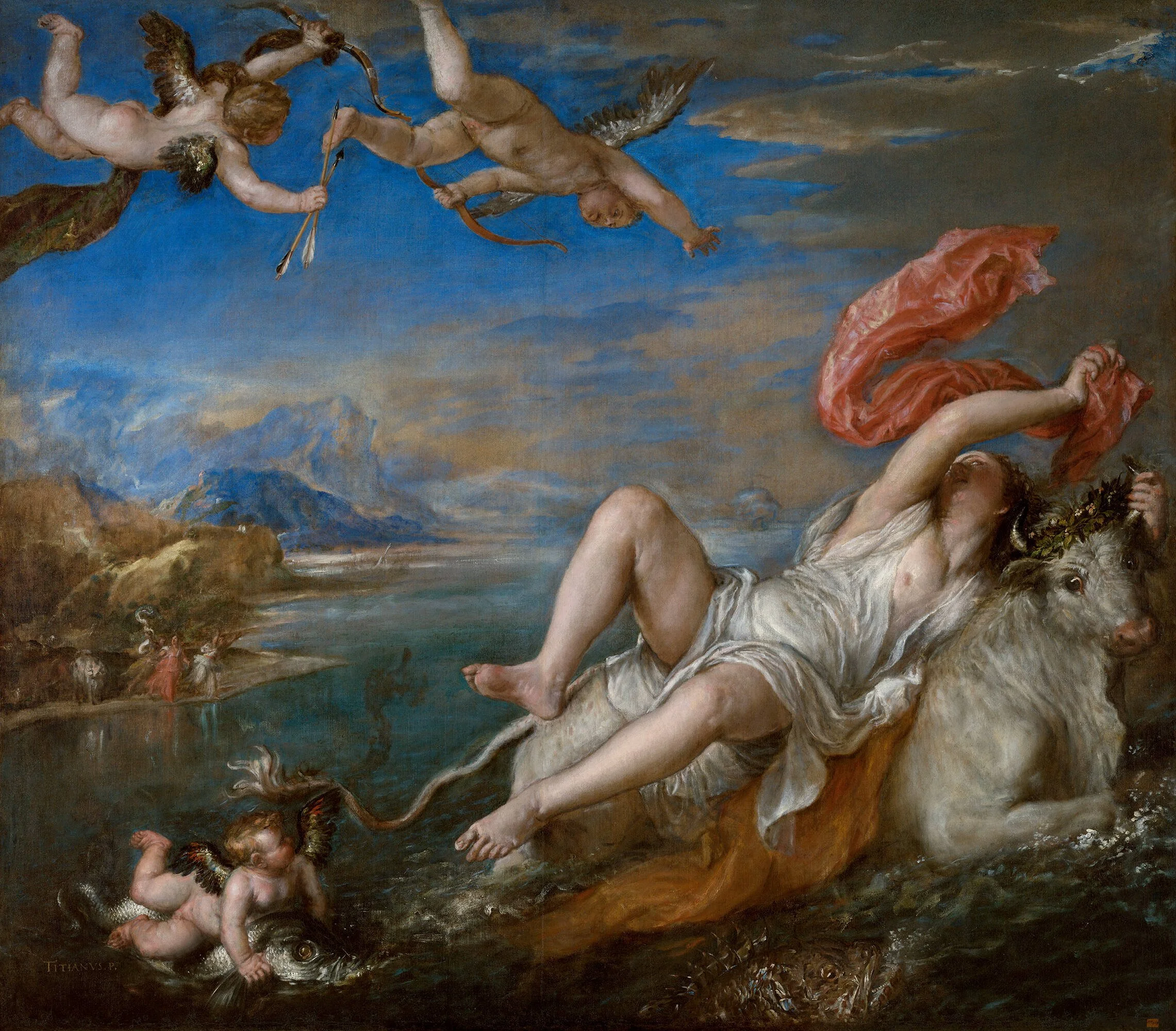
The Rape of Europa | Isabella Stewart Gardner Museum
One of my favourite things about the work I do at The Celestial Archive is how much research goes into learning about the stories that sit above our heads. If you’re looking at the constellations through the lens of Ancient Greece, you’ll encounter tales of heroes, monsters, and the complicated – and often brutal – relationships between gods and mortals. But dig a little deeper and you soon begin to realise those romanticised myths are laced with something much darker.
The Monster We Made
Naive perhaps, but my first realisation that not all may be well with these legendary tales was the story of Medusa. We all know her as the monster, the gorgon whose gaze turned men to stone, slain by the hero Perseus. But beneath that version of the story is something far more troubling.
Medusa was not born a monster. She was an innocent young woman in every sense of the word; a priestess of Athena, who was punished for an act of violence committed against her. She hid herself away to spare innocent people from her fatal gaze. She was not hunting anyone. She was surviving. And yet we remember her as the villain of the story, and Perseus, the man who hunted her down, as the hero.
So why wasn’t this the story that was told? Why is the only constellation associated with her tragic tale that of Pegasus, the famed white horse who sprouted from her severed head? As if poor Medusa was simply the wretched soil something beautiful clawed its way out of.
The Bull in the Stars
Thankfully, most of my research through the zodiac constellations was inoffensive. Tales of familial love, self-sacrifice, romance. Thoroughly enjoyable.
And then I reached Taurus.
The myth behind the Bull is the story of Europa, a Phoenician princess known for her beauty and gentleness. Zeus became fixated on her. Knowing she would be afraid of him if he approached directly, he disguised himself as a bull. But not just any bull: one specifically crafted to earn her trust. White. Calm. Beautiful. The kind of creature a young woman collecting flowers on a beach might feel safe enough to approach, to touch, perhaps even to climb upon.
That detail stops me every time I think about it. The deliberate construction of trust, as a means to an end. As soon as Europa sat on his back, Zeus charged into the sea and swam to Crete, where he revealed his true form. What followed is recorded in historical accounts as ‘The Rape of Europa’. There is no ambiguity in the language. No attempt to soften it even by ancient mythology standards.
The story goes that Europa went on to bear Zeus three sons. And Zeus, to commemorate the occasion, placed his bull disguise in the stars for all eternity. Taurus. One of the oldest and most recognised constellations in the sky.
What Do We Do With This?
I have thought a lot about my responsibility here. These are, after all, works of fiction – myths passed down across thousands of years. They were never meant to be taken literally. But I don’t think that’s quite the point.
Myths are not just stories. They are a record of how a society understood itself, who had power, who deserved protection, whose suffering was worth commemorating and whose was simply a cog in a bigger, more “important” story. When we retell these myths uncritically, we inherit that framework too. After all, mythology is one of the oldest forms of storytelling – and at its heart, what is storytelling? It’s communication.
For now, I am focusing on what else this constellation represents. If you are a Taurus, you should know that your constellation is one of the oldest navigational guides in human history, predating even the Greeks. Taurus guided sailors home long before any myth was attached to it. It undoubtedly saved hundreds of thousands of lives, reuniting loved ones and showing lost souls a safe way home. That story belongs to you too.
Adding New Life to Old Myths
The deeper my research goes, the more I suspect this is actually the most important work Leo & Luna does. Not just celebrating the beauty of the night sky, but being honest about the stories written into it.
Medusa can no longer simply be a monster. Europa can no longer exist purely as Zeus’s lover. These were women, fictional perhaps, but modelled on the reality of what it meant to be a woman in the ancient world. Their stories deserve to be told fully, not as stepping stones in a self-appointed hero’s journey.
So that is what I intend to do. To uncover these old tales and honour the women at the centre of them. To sit with the uncomfortable parts rather than smooth them away. To look up at the night sky and see not just beauty, but history, all of it, including the parts that ask something of us.
Each journal piece takes hours of research, reading and writing. I'll never put it behind a paywall – these stories belong to everyone. But if you'd like to help fuel the next one, I'd be truly grateful.
Discover the artwork that inspired the blog
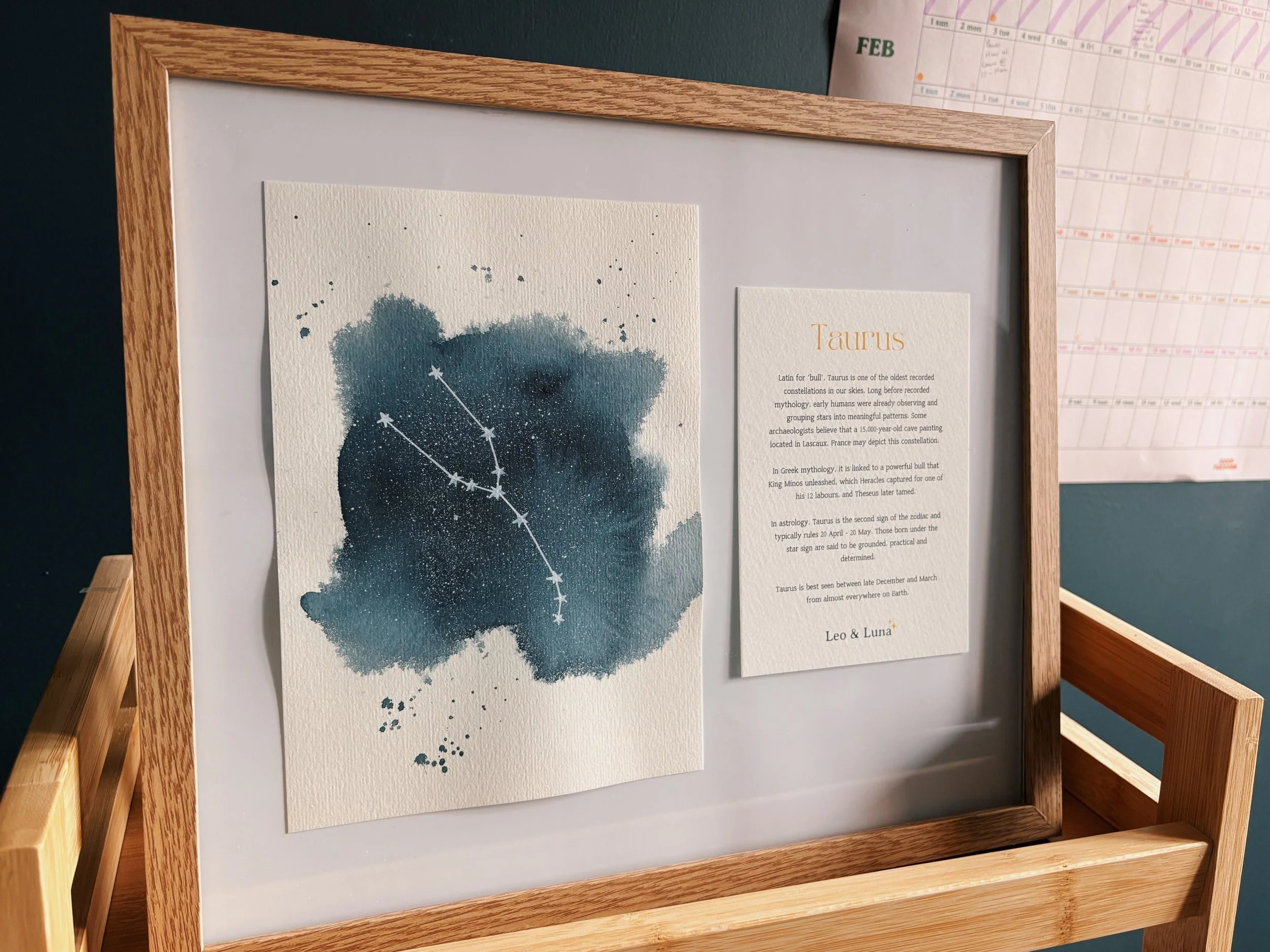
This original hand-painted Taurus zodiac constellation artwork is a truly unique piece, bringing ancient mythology and astronomy into a collector-worthy, ready-to-display work of art. Taurus, also known as the Bull, has long been an enduring figure in celestial storytelling and astrology alike.
What you’re getting
Original hand-painted artwork (1/1) created using deeply rich watercolour
Presented in an 8×10" oak-effect frame (FSC certified)
Free-standing or wall-mounted
Presented next to a carefully researched and detailed history note
The framed history note explores
The constellation’s mythological origins
Its role and significance in astronomy
When the constellation is visible in the night sky
Edition: 1/1 — this listing is for the original hand-painted artwork.
While this original may be reproduced as part of the artist’s A6 pocket constellation and greeting card collections, no other hand-painted versions of this piece will ever be created.