
Aries: The Meaning Behind the Constellation
“I always thought it was rather boring.”
If I had a pound for everyone that comes out with that line when looking at one of my Aries prints, I’d have a stable new income stream. Just three simple lines slashed across the night sky.
If you were to look up, you’d have a hard time spotting it too, Aries is one of the smallest and faintest constellations ever recorded. On the surface, it doesn’t seem like a whole lot of anything.
But dig a little deeper and you’ll unearth a wealth of astronomical and cultural significance.

For starters, Aries is the first sign of the zodiac, marking the beginning of the astrological year. It’s also one of the 88 modern constellations and has been recognised and respected since it was first recorded thousands of years ago. But that’s just the beginning.
Greek Mythology
Latin for 'ram', Aries is based on the ancient Greek myth of the ram with the golden fleece. The mother of a young man named Phrixus who was about to be sacrificed to the gods, sent this ram to carry him away to safety. So grateful was he to be rescued that he sacrificed the ram to Zeus then hid its golden fleece so no one could steal it.
Many years later, Jason, a hero who had his crown stolen by his uncle, sailed his ship, the Argo, on an epic journey to retrieve the golden fleece and prove himself worthy of the throne. Along with his crew known as the Argonauts, Jason overcame many challenges to recover the fleece and become the rightful king.
Just like many other zodiac constellations, Aries was recorded by the great Greek astronomer, Ptolemy. But we’ll explore him in more depth another time.
Babylonian culture
What differentiates Aries from other zodiac constellations is that its symbolism and imagery have evolved over time. Almost 1000 years before Ancient Greece, the Babylonians did not always depict the constellation as a ram. At one time, Aries was depicted as a farmworker, also known as the agrarian worker. No one is sure when the switch happened, but historians believe the constellation was used to depict both images interchangeably for some time before it was solidified as a ram in Ancient Greece.
Ancient Egypt
To the ancient Egyptians, the Aries constellation was heavily associated with Amun-Ra. You might recognise that name from the 1999 film The Mummy, where it was referenced in the name of the legendary mechanical book used to take away life: ‘The Book of Amun-Ra’ or ‘Book of the Living’.
In reality, Amun-Ra was an actual Ancient Egyptian deity – a combination of the wind god Amun and the sun god Ra. He was often depicted as a ram or man with a ram’s head and represented fertility and creativity. Around 1400-1100 BC, the sun was in Aries during the spring equinox and influenced temple orientation, which led to celebrations that honoured the ram.
Aries in the zodiac
According to astrology, Aries is the first sign of the zodiac and typically governs the period from 21 March to 19 April. Represented by the ram and ruled by Mars, it’s a cardinal fire sign and those born under its rule are said to be courageous, energetic, impulsive and pioneering. They are passionate, fierce and determined.

How to find the Aries constellation
Aries is a small and faint constellation located in the Northern Hemisphere. It is best seen between late September and late December and is bordered by the constellations Cetus, Perseus, Pisces, Taurus and Triangulum.
Each journal piece takes hours of research, reading and writing. I'll never put it behind a paywall – I believe these stories belong to everyone. But if you'd like to help fuel the next one, I'd be truly grateful.
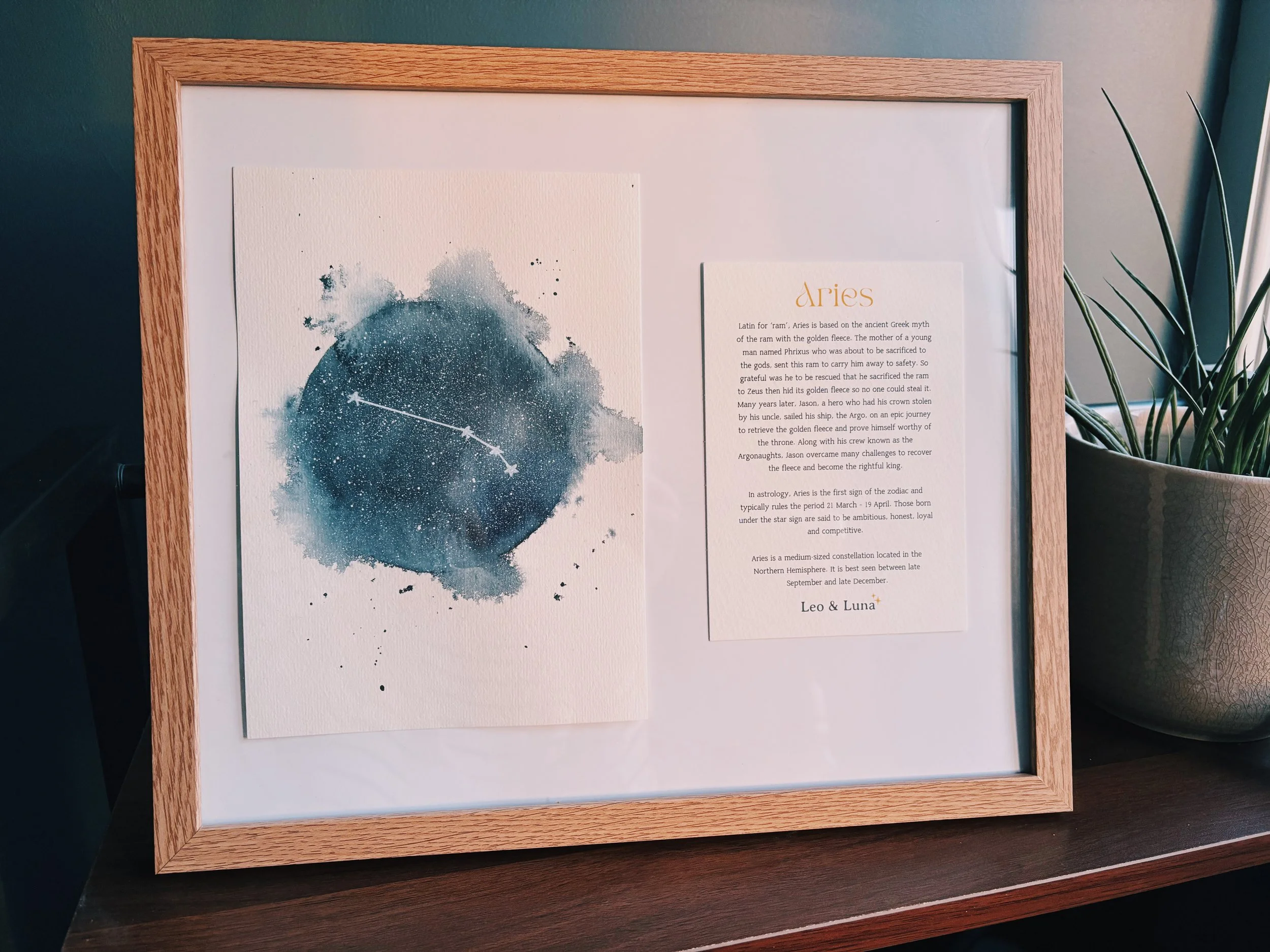
Aries
The Ram
A constellation honouring the legend of the Golden Fleece
Celebrate the magic of the night sky with this delicate A6 Keep & Frame Greeting Card.
Originally hand-painted in delicate watercolour and ink, this card is professionally reprinted on premium 316gsm fine art paper to preserve every brushstroke and soft celestial detail. It’s designed to be framed and treasured long after the festivities end.
Leave your message inside, gift it to someone special, and let the artwork live on as a beautiful seasonal print.
Includes brown Kraft envelope.
3 for £10 and 5 for £15 bundles also available